
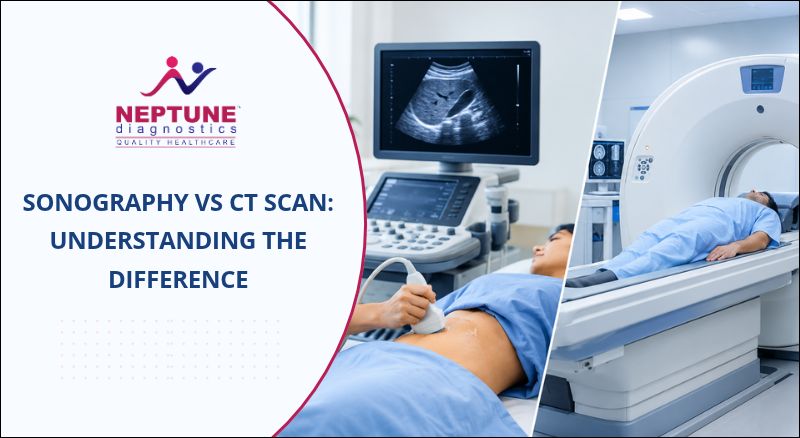
When a doctor recommends a medical scan, it is natural to wonder which test is better and why it is needed. Two commonly used imaging tests are sonography and CT scans. Both help doctors examine internal organs and identify health problems, but they work differently and serve different purposes.
Understanding the difference between sonography and a CT scan can help you feel more confident when preparing for a diagnostic test. The right scan depends on your symptoms, medical history, and what your doctor needs to investigate.
What Is Sonography?
Sonography, also known as ultrasound, is a medical imaging test that uses high-frequency sound waves to create images of organs and structures inside the body.
During the test, a technician applies a special gel to the skin and moves a small device called a transducer over the area being examined. The device sends sound waves into the body and receives their echoes to create images on a screen.
Sonography is commonly used to examine the abdomen, pelvis, kidneys, liver, gallbladder, thyroid gland, and other soft tissues. It is also widely used during pregnancy to monitor the baby’s growth and development.
When Is Sonography Recommended?
Doctors may recommend sonography for several reasons, including:
- Investigating abdominal pain or swelling.
- Detecting gallstones and certain kidney stones.
- Examining the liver, kidneys, and gallbladder.
- Evaluating lumps or swelling in soft tissues.
- Monitoring pregnancy.
- Assessing certain blood vessels using Doppler ultrasound.
Benefits of Sonography
One of the biggest advantages of sonography is that it does not use ionising radiation. It is generally painless, non-invasive, and suitable for many patients, including pregnant women when medically indicated.
It also provides real-time images, allowing doctors to observe movement and blood flow in certain structures.
However, ultrasound has limitations. Sound waves do not travel well through air or bone, and image quality may be affected by body structure and the area being examined. Therefore, sonography may not provide enough information for every medical condition.
What Is a CT Scan?
A CT scan, or Computed Tomography scan, is an imaging test that uses X-rays and computer processing to create detailed cross-sectional images of the body.
Unlike a standard X-ray, which produces a more general two-dimensional image, a CT scan creates multiple images of different sections of the body. These images can also be combined to produce detailed views of internal structures.
CT scans are commonly used to examine the brain, chest, abdomen, bones, lungs, and internal organs. In some cases, doctors may use a contrast agent to make specific tissues, blood vessels, or abnormalities easier to identify.
When Is a CT Scan Recommended?
A doctor may recommend a CT scan to:
- Investigate serious or unexplained abdominal pain.
- Detect internal injuries after an accident.
- Evaluate certain lung conditions.
- Identify bleeding or injuries in the brain.
- Examine complex fractures.
- Detect or assess certain tumours and other abnormalities.
- Investigate suspected conditions that require detailed internal imaging.
Benefits of a CT Scan
CT scans provide detailed images of many internal structures and can be especially useful in emergencies. They are often helpful when doctors need to assess injuries, internal bleeding, or conditions that cannot be clearly evaluated through an ultrasound.
However, CT scans use ionising radiation. The benefits and potential risks should be considered, particularly for children, pregnant patients, and people who may require repeated scans. Contrast agents may also carry risks for certain patients, depending on their medical history and kidney function.
Which Is Better: Sonography or CT Scan?
The answer depends on your symptoms and the area of the body being examined.
For example, if you have abdominal discomfort and your doctor suspects gallstones, sonography may be the first choice. It can help examine the gallbladder and identify stones without exposing you to ionising radiation.
On the other hand, if you have sustained a serious injury or the doctor suspects internal bleeding, a CT scan may provide the detailed information needed for a quicker diagnosis.
Similarly, ultrasound is often preferred for routine pregnancy imaging, while CT may be useful for evaluating certain complex injuries or conditions involving the lungs and other internal structures.
In some situations, your doctor may recommend both tests because they provide different types of information. The decision should always be based on your medical needs rather than choosing a scan simply because it is more advanced or readily available.
Is Sonography Safer Than a CT Scan?
Sonography does not use ionising radiation, which makes it a useful option when the condition can be adequately assessed using ultrasound. This is particularly important during pregnancy.
A CT scan, however, can be essential when detailed imaging is needed to diagnose a potentially serious condition. Although it involves radiation, the risk from an appropriately indicated scan is generally outweighed by its expected medical benefit.
If you are pregnant, have kidney problems, have experienced an allergic reaction to contrast agents, or have undergone several imaging tests recently, inform your doctor before the examination.
Remember that the safest test is the one that provides the necessary diagnostic information with an appropriate balance of benefits and risks.
How to Prepare for Sonography or a CT Scan
Preparation depends on the body part being examined and the type of scan prescribed.
For sonography, you may be asked to drink water and keep your bladder full before a pelvic scan. For an abdominal ultrasound, fasting for a few hours may be necessary to improve image quality.
For a CT scan, you may need to remove metal objects and follow specific instructions regarding food, fluids, or medications. If contrast material is planned, the diagnostic centre may ask about your allergies, kidney function, and relevant medical history.
Always follow the instructions provided by your doctor or diagnostic centre. Do not stop prescribed medication unless your healthcare professional advises you to do so.
Choose the Right Diagnostic Test at Neptune Diagnostics
If you are looking for a reliable sonography center in Ghatkopar West, Neptune Diagnostics Center can be a convenient option to consider for your diagnostic imaging needs. Choosing an appropriate imaging centre helps ensure that your examination is performed according to the doctor’s instructions and that the results can support further medical evaluation. Whether you need an ultrasound to investigate abdominal discomfort, assess internal organs, or undergo another prescribed sonography examination, discuss your requirements with the diagnostic team beforehand. At Neptune Diagnostics, patients can seek guidance about the preparation required for their scan and the next steps for obtaining their reports. Always consult your doctor to determine whether sonography or a CT scan is more appropriate for your condition.
Frequently Asked Questions (FAQs)
1. What is the main difference between sonography and a CT scan?
Sonography uses sound waves, while a CT scan uses X-rays and computer processing to create detailed images of the body.
2. Is sonography safer than a CT scan?
Sonography does not use ionising radiation. CT scans use radiation but may be necessary for diagnosing certain conditions accurately.
3. Can sonography detect all diseases?
No. Sonography can detect many abnormalities, but some conditions require a CT scan, MRI, or another diagnostic test.
4. Is a CT scan better for abdominal pain?
It depends on the suspected cause. Ultrasound is useful for conditions such as gallstones, while CT may be preferred for other abdominal problems.
5. Do I need a doctor’s prescription for sonography or a CT scan?
The need for a prescription depends on the examination and local requirements. Medical guidance helps ensure that the appropriate test is selected.