
Medical imaging plays a crucial role in modern healthcare. It allows doctors to see inside the body without surgery and helps diagnose diseases early. Two of the most commonly recommended imaging tests are CT scans and MRI scans. While both provide detailed images of the body, they use very different technologies and are used for different medical conditions.
What is a CT Scan?
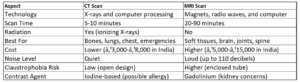
A CT scan (Computed Tomography) uses X-rays and computer processing to create detailed cross-sectional images of your body. It’s like slicing a loaf of bread to see inside each “slice” builds a 3D picture.
- Best for: Detecting bone injuries, internal bleeding, tumors, or lung issues.
- Scan time: Just 5-10 minutes super fast for emergencies.
- Common uses: Trauma cases, chest infections, or abdominal pain.
What is an MRI Scan?
An MRI (Magnetic Resonance Imaging) employs powerful magnets and radio waves to produce high-resolution images of soft tissues. Think of it as a non-invasive microscope for your organs.
- Ideal for: Brain scans, spinal cord issues, joints, muscles, and cancers.
- Scan time: 20-60 minutes, so bring a podcast!
- Key advantage: No radiation, making it safer for repeated use.
Which Scan is Better: CT Scan or MRI?
Many patients ask which scan is better, but the truth is that both tests serve different purposes.
The choice between a CT scan and an MRI depends on:
- The symptoms you are experiencing
- The part of the body being examined
- The medical condition your doctor suspects
- How quickly results are needed
For example:
If a patient has head trauma or internal bleeding, doctors usually recommend a CT scan because it is faster.
If a patient has brain, nerve, or ligament problems, an MRI scan is usually more effective.
CT Scan vs MRI: Key Differences
Safety Considerations
- Both CT scans and MRI scans are generally safe when performed by trained professionals.
- CT scans involve low levels of radiation, but doctors limit exposure whenever possible.
- MRI scans are safe for most patients but may not be suitable for people with metal implants or certain medical devices.
Preparing for a CT Scan or MRI
Preparation may vary depending on the type of scan.
CT Scan Preparation
- You may need to avoid food for a few hours before the test.
- Sometimes a contrast dye is injected to improve image clarity.
- Remove metal objects such as jewelry.
MRI Preparation
- Remove all metal objects before entering the MRI room.
- Inform the doctor if you have implants, pacemakers, or metal fragments in your body.
- Some MRI scans also use contrast agents.
While CT scans and MRIs are both essential diagnostic imaging tools, the choice between them depends on the patient’s specific medical condition and the type of detail required for diagnosis. Consulting with the specialists at Neptune Diagnostics Centre helps ensure that the most appropriate imaging method is selected, allowing for an accurate diagnosis and timely, effective treatment.
Frequently Asked Questions (FAQs)
Is a CT scan faster than an MRI?
Yes, a CT scan is much faster than an MRI. Most CT scans take 5 to 10 minutes, while MRI scans may take 30 to 60 minutes depending on the body part being examined.
Is MRI safer than a CT scan?
MRI scans do not use radiation, which makes them safer for repeated imaging in some cases. CT scans use a small amount of radiation, but they are generally considered safe when used for medical diagnosis.
Do I need a doctor’s prescription for a CT scan or MRI?
Yes, in most cases a doctor’s referral or prescription is required before undergoing a CT scan or MRI. This ensures the correct imaging test is performed for accurate diagnosis.
Which is better for seeing bones?
CT scan is the gold standard for bone imaging. It provides superior detail for complex fractures, bone tumors, and dental issues