
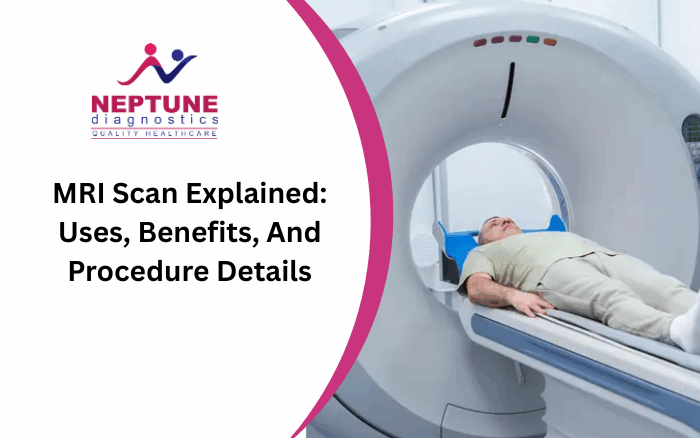
Magnetic Resonance Imaging, commonly known as MRI, has revolutionized medical diagnostics by providing detailed images of the body’s internal structures. Unlike X-rays or CT scans, MRI does not use harmful radiation, making it a safer choice for frequent imaging. If you’re curious about how an MRI scan works, its uses, and what to expect during the procedure, this guide will cover everything you need to know.
What is an MRI Scan?
An MRI scan is a non-invasive imaging technique that uses strong magnetic fields and radio waves to create detailed images of organs, tissues, and bones. These images help doctors detect and monitor a wide range of medical conditions. The high-resolution images provided by MRI allow healthcare professionals to diagnose issues that may not be visible through other imaging methods.
The principle behind MRI involves aligning the hydrogen atoms in your body using a magnetic field. Radio waves then disturb this alignment, and the signals emitted as the atoms return to their original state are used to generate detailed cross-sectional images.
Common Uses of MRI Scans
MRI scans are versatile and can be used to examine nearly any part of the body. Some of the most common uses include:
• Brain and Spinal Cord Imaging: Detects tumors, strokes, multiple sclerosis, and other neurological conditions.
• Heart and Blood Vessel Examination: Evaluates heart function, blocked arteries, and vascular anomalies.
• Abdominal and Pelvic Imaging: Identifies liver, kidney, or reproductive organ problems.
• Cancer Detection: Helps locate tumors and monitor response to treatment.
Because MRI scans can provide highly detailed images, they are often the preferred method for diagnosing complex conditions or monitoring disease progression.
Benefits of an MRI Scan
MRI scans offer several advantages over other diagnostic tools:
-
Non-Invasive and Safe
Unlike CT scans or X-rays, MRI does not use ionizing radiation, which makes it safer for repeated use and for sensitive populations, including pregnant women. -
High-Resolution Imaging
MRI provides detailed images of soft tissues, which are often difficult to capture with X-rays. This allows for more accurate diagnoses. -
Early Detection of Diseases
MRI can detect abnormalities at an early stage, helping doctors initiate timely treatment and improve outcomes. -
Versatile and Comprehensive
From joints to organs, MRI can assess multiple body parts in a single session, reducing the need for multiple tests. -
Non-Surgical Diagnosis
MRI scans often eliminate the need for exploratory surgeries, reducing risk and recovery time.
How to Prepare for an MRI Scan
Preparation for an MRI scan is usually straightforward. Here’s what patients should know:
• Remove Metal Objects: Since MRI uses strong magnets, all metal jewelry, watches, or implants need to be removed or reported to the technician.
• Clothing: Patients may be asked to wear hospital gowns or clothing free of metal.
• Fasting: For certain scans, such as abdominal MRI, fasting for a few hours may be required.
• Medical History: Inform your doctor if you have pacemakers, cochlear implants, or metal fragments in your body.
• Claustrophobia Management: If you are anxious about enclosed spaces, discuss sedation options with your doctor.
Following these steps ensures a smooth and safe MRI experience.
What to Expect During the Procedure
An MRI scan is typically painless, but it can be a bit noisy and time-consuming. Here’s a step-by-step overview:
-
Positioning: You will lie down on a movable table that slides into the MRI machine’s cylindrical chamber.
-
Immobility: Staying still is crucial for clear images. Technicians may use cushions or straps to help maintain your position.
-
Noise: The machine produces loud tapping or thumping sounds. Earplugs or headphones are usually provided for comfort.
-
Duration: Depending on the body part being scanned, the procedure can take 15 to 60 minutes.
-
Contrast Agents: In some cases, a contrast dye may be injected into your vein to enhance image clarity.
-
Completion: After the scan, you can resume normal activities immediately, unless sedatives were used.
Understanding MRI Results
Once the MRI scan is complete, a radiologist interprets the images and prepares a report for your doctor. Depending on the complexity, results may be available within a few hours to a few days. Your doctor will then discuss the findings and recommend next steps, whether it’s further testing, treatment, or routine monitoring.
Risks and Considerations
While MRI scans are generally safe, a few precautions are necessary:
• Patients with metal implants, pacemakers, or stents need specialized MRI machines.
• Contrast dyes may cause allergic reactions in rare cases.
• Claustrophobic patients might experience anxiety, which can be managed with sedation or open MRI systems.
Consulting with your doctor before the scan ensures that the procedure is safe for your specific situation.
MRI scans are an essential tool in modern medical diagnostics, offering detailed, non-invasive insights into the body’s organs, tissues, and bones. From detecting neurological conditions to evaluating soft tissue injuries, MRI scans help doctors make accurate diagnoses and guide effective treatment plans.
If you’re looking for reliable and advanced MRI services, trust the experts at Neptune Diagnostics Center. With state-of-the-art equipment and experienced radiologists, they ensure a safe, comfortable, and precise imaging experience for every patient. Scheduling your MRI at Neptune Diagnostics Center can give you the clarity and confidence you need to take control of your health.
Frequently Asked Questions (FAQs) About MRI Scans
1. Is an MRI scan safe for everyone?
Yes, MRI scans are generally safe for most people because they do not use harmful radiation. However, patients with pacemakers, certain metal implants, or cochlear implants should consult their doctor before the scan.
2. How long does an MRI scan take?
The duration of an MRI scan depends on the body part being examined. Most scans take between 15 to 60 minutes. More complex scans may take slightly longer.
3. Do I need to fast before an MRI scan?
Fasting is only required for certain types of MRI scans, such as abdominal or pelvic imaging. Your doctor or technician will provide specific instructions before your appointment.
4. Will I feel any pain during the MRI procedure?
MRI scans are non-invasive and typically painless. Some patients may feel slight discomfort from lying still or from the injection of contrast dye if required.
5. How soon will I get my MRI results?
MRI results are usually interpreted by a radiologist and sent to your doctor. Depending on the facility, results can be available within a few hours to a few days. Your doctor will discuss the findings and next steps with you.